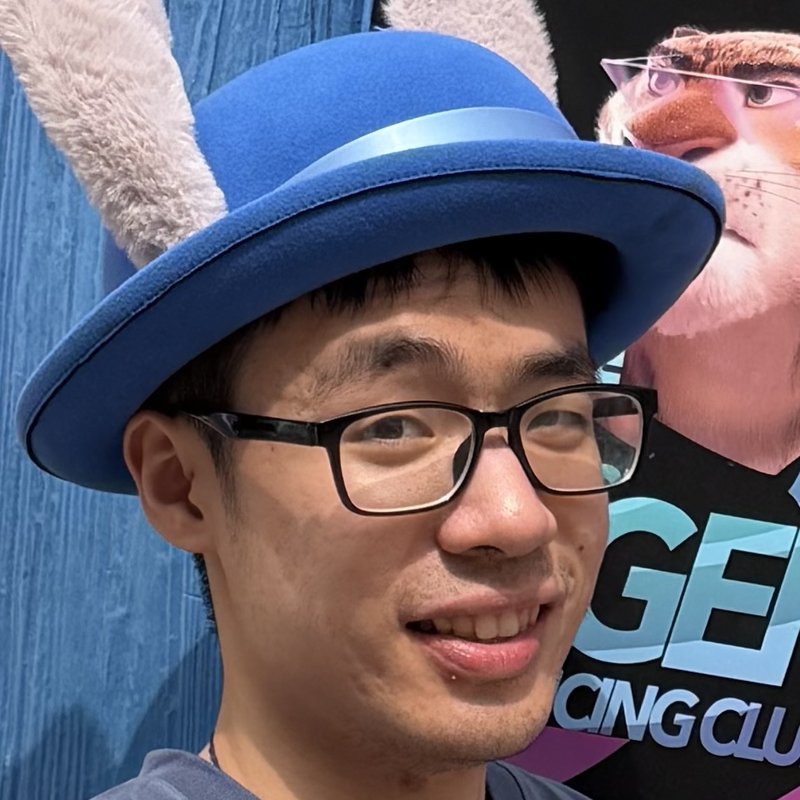
Ph.D. Student · Capital One Fellow
Zhenyu (Fischer) Lei
E-mail: vjd5zr [at] virginia [dot] edu
Address: Charlottesville, VA, USA
I am a Ph.D. student in Electrical and Computer Engineering at the University of Virginia, advised by Prof. Jundong Li, and a Capital One PhD Fellow. Before that, I received my B.S. in Physics from Xi'an Jiaotong University, where I was lucky to join the LUD Lab. I have also interned at AT&T as an Applied Scientist.
I am interested in LLM agents, memory, recursive self-improvement (RSI), and distillation, as well as graph and time series learning. I also built Good Papers, a site where readers and AI reviewers rate which ML papers are worth reading. I am open to collaborations and discussions — feel free to reach out by email or the message box! Actively looking for research internships!
News
LatestOct 2026Launched Good Papers, a site to find which ML papers are worth reading, with reader votes and AI reviewers. Covers all NeurIPS 2026 papers.
Sep 2026One paper accepted at NeurIPS 2026 (AdaST).
Aug 2026Two papers accepted at EMNLP 2026 (MemSuit and TeacherGRPO).
June 2026Honored to receive the Capital One PhD Fellowship.
Jan 2026One paper accepted at ICLR 2026 (REdit).
Publications
All publications →
Selected Research
Grounding Memory Summarization in Utility Intent
TeacherGRPO: Closing the Capacity Gap in Reasoning Distillation via Teacher Alignment
AdaST: Adaptive Coupling for Spatial-Temporal Forecasting
* equal contribution
Background
Education & Experience
UVA
University of Virginia, USAPh.D. in Electrical and Computer Engineering · Advisor: Prof. Jundong Li
2023.08 – present
XJTU
Xi'an Jiaotong University, ChinaB.S. in Physics (Honor) · GPA 89.5/100 · Advisor: Prof. Minnan Luo
2019.08 – 2023.07
AT&T
AT&T, Bedminster, NJApplied Scientist Intern · Host: Dr. Qiong Wu
2025.06 – 2025.08
Recognition
Selected Honors & Awards
Capital One PhD Fellowship, 2025–26WSDM Student Travel AwardPresidential Fellowship in Collaborative Neuroscience, UVAPrecision Health Initiative Trainee Travel Stipend, UVATYDE Student Training Award, UVAEngineering Academic Commitment to Excellence (ACE) Fellowship, UVA
Community
Service
Reviewer: CIKM (2025), COLM (2024, 2025), KDD (2024, 2025), ARR (Dec 2023–), NeurIPS (2023)Volunteer: ACL 2023 (virtual)